Saturday, November 24, 2012
YEAR 1995: XENA WARRIOR PRINCESS
Buffy the Vampire Slayer got out of the gate first and maintained popular in comic books some time after the demise of her television series. Despite that, Xena-- who premiered on an episode of HERCULES: THE LEGENDARY JOURNEYS before gaining her own series the same year-- is arguably the more ambitious femme formidable.
To say "ambitious" is not to portray the teleseries as something artsy and high-falutin'. XENA the series borrowed from a variety of popular sources-- sword-and-sandal movies, Hong Kong kung-fu films, dungeons-and-dragons and even westerns. Nevertheless, the writers were gutsy enough to simulatenously swipe from highbrow works like Greek epic and the Bible or from philosophers like Schopenhauer, resulting in a unique blend of the "high" and "low" that BUFFY can't quite match.
The theme of the warrior trying to turn his/her deadly skills to good ends is a favorite American theme, but the creators of XENA upped the ante. XENA episodes often concern the necessity for characters to "let go" of the lust for hate or vengeance -- and not only the villains. Both Xena and her sidekick Gabrielle frequently have to practice what they preach, and they don't always do so successfully. The Schopenhauerean ideal of relinquishing the will plays better than it lives.
Not to mention that in addition to all this philosophical complexity, Xena also had better fight-choreography than Buffy--
AND--
A better all-musical episode.
Monday, November 19, 2012
YEAR 1994: KAHLAN AMNELL
I haven't featured many characters as yet from the genre of prose fantasy, but I would remiss not to mention one of the better ones of the 1990s, Kahlan Amnell from Terry Goodkind's SWORD OF TRUTH series.
However, for the time being, this will have to be something of a placeholder, since I confess I've only read the first in Goodkind's multi-book series. I can provide no overall perspective as to how the character of Kahlan develops over the course of the series. Like many fantasy-fans I've seen the LEGEND OF THE SEEKER teleseries, but as this changes up the events of the books, this can hardly be a resource.
I might go out on a limb and say that Kahlan is notable for being an equal partner to the male hero in the course of the series, and that her particular power as a "Mother Confessor" is integral to Goodkind's take on magical power in his fantasy-sphere.
To top it off, I quote from the Sword of Truth Wiki:
"Outside of the Sword of Truth universe, Terry Goodkind reports that Kahlan was the first character he thought of, and that her iconic scene running from the D'Haran quad sparked the entire series."
Sunday, November 11, 2012
YEAR 1993: LOIS LANE
From the late 1960s on, the comic book Lois Lane had become noticably tougher, often if not consistently capable of taking out gunmen with karate chops. But the Lois Lane seen in both live-action and animated television shows was nearly incapable of self-defense. The Margot Kidder Lois of the big-budget SUPERMAN films displayed a modicum of "street savvy" and gutsiness, but she didn't seem like the sort of reporter who could mix it up with a batch of gun-wielding thugs.
Though 1993's LOIS AND CLARK: THE NEW ADVENTURES OF SUPERMAN often played Lois for comic effect, the writers gave her greater efficacy in compensation. Portrayed as the child of an army brat, Teri Hatcher's Lois had a genuine appreciation for the martial arts, as displayed in the Season 2 episode "Chi of Steel." Though she still didn't mow down small armies of thugs, she was frequently seen trading karate chops with assassins or punching out the henchman of the Villain of the Week.
Tuesday, November 6, 2012
YEAR 1992: BUFFY THE VAMPIRE SLAYER
Year 1992 should probably get the honorary title of "the Year of the Woman Superhero." It's not that Buffy was the best superhero, or even the best of her horror-oriented subgenre. But in contrast to the live-action flops of SUPERGIRL and SHEENA (both 1984), BUFFY the film was at least a modest success-- which led to the 1997 teleseries.
So what about the original film? Scripter Joss Whedon has said many times that the director wanted it to be more of a comedy than Whedon did. Without my seeing the original Whedon script, I can't judge whether it looks like the director made massive changes. The final shooting script is extremely loose, though, and only rarely does the potential of the concept come across.
It's neither a very funny nor very thrilling film, though Kirsty Swanson (unlike male lead Luke Perry) at least plays the concept relatively straight. In the history of the femmes formidables, BUFFY the movie is essentially an interesting footnote.
Friday, October 26, 2012
YEAR 1991: V.I. WARSHAWSKI
The main point of interest in the film V.I. WARSHAWSKI-- a critical and commercial flop in its day-- is that it might be considered a minor herald of the burgeoning "tough heroine" subgenre that proliferated during this decade.
I haven't read the source-novel by Sara Paretsky, so I can't make an extended comparison. All I remember is that though Kathleen Turner looked great in the role-- garnering what few raves the film got-- the rendition was just another generic Hollywood action-opus, failing to underscore any of the Warshawski character's particular concerns with women's issues.
It does have one kickass scene where Turner's Warshawski has to take a beating from a low-grade thug before she manages to turn the tables on him. Quite a change from the days of the old serials, where heroines almost instantly fainted the first time a bad guy pushed them to the floor.
Saturday, October 20, 2012
YEAR 1990: BREATHLESS MAHONEY
At the risk of pissing off any readers who haven't seen the 1990 Warren Beatty-Madonna DICK TRACY, I'm spoiling the ending: the mysterious masked mastermind known as "the Blank" is none other than Madonna's character Breathless Mahoney.
As noted in my writeup of the comic-strip Breathless, the original character was something less than a high-roller. She's not even a major seductress as per the then-current Madonna personality (not that Chester Gould created a lot of seductress-types). There's nothing much in common between the original and the film-version except the name. It may one of the few times, if not the only time, that a secondary medium improved on not one but two of DICK TRACY's classic villains.
For most of the film, Breathless seems to be one of the typical "bad girls" of film noir, set to tempt the hero-- Dick Tracy in this case-- from his loyalty to a pretty-but-not-glamorous "good girl." Breathless does a pretty good job of keeping Beatty's Tracy "out of breath," but her role in the story seems tangential to Tracy's war on the criminal forces of Big Boy Caprice (Al Pacino) and his many strip-derived allies: Flat Top, Itchy, Prune Face, etc. At the same time Tracy also has to contend with a mysterious blank-faced man trying to take over Caprice's criminal empire. Surprise ending: when it all shakes out, behind the Blank's mask is the face that launched a thousand, uh, fans.
The plot never expands on what motivated Breathless to become a supervillain. However, there is one crucial scene that proves suggestive: after Big Boy takes over the club where Breathless performs, the goony-looking gangster not only takes charge of her career but tries to tell her how to perform as well. That sounds like good enough motivation to turn to crime right there.
I mentioned that the film does two DICK TRACY villains better than the originals, by which I meant that the original Blank, while interesting (and male), is something less than one of the classic Tracy villains.
Wednesday, October 17, 2012
YEAR 1989: THE WOMEN OF THE WOLF
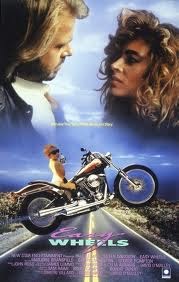
1989 is rather a dub year for femmes formidables, but the comic biker-flick EASY WHEELS deserves to be a bit better-known.
In this deadpan-comic twist on such serious-toned lady-biker films as SHE-DEVILS ON WHEELS and THE MINI-SKIRT MOB, Sam and Ivan Raimi, along with director David O'Malley, introduce the audience to "She-Wolf" (Eileen Davidson), a woman raised by wolves. When she grows to adulthood She-Wolf goes the Pussy Galore route and assembles an all-female biker-gang around her, "The Women of the Wolf." Implicitly they have Lesbian Nation ambitions, for they steal babies after the manner of the archaic Amazons, selling the male babies to illegal adoption agencies and allowing the girl babies to be raised by the wolfpack, as She-Wolf was.
The Wolf-Women have everything going for them until they run across a gang of all-male bikers, whose name, "The Born Losers," contains more truth than poetry. The guys aren't much of a physical threat to the lady bikers, who kick the guys' butts in two separate encounters. Rather, their presence threatens the stability of the group when She-Wolf unintentionally strays from the Isle of Lesbos and falls in love with the Loser-leader Bruce (Paul LeMat).
EASY is pretty tame material, but it sports some nice light-hearted brawls. Sam Raimi would gain greater fame in the Femme Formidable department about six years later when he produced the XENA teleseries.
Subscribe to:
Posts (Atom)